Showing posts with label abada family. Show all posts

Friday, 27 October 2017

Mayor Alfredo Locsin Montelibano


So one day, I was sitting there, looking around on the internet for more people to add to my family when I chanced upon the family of the late mayor of Bacolod City, my place of birth. He was attached through the Javellana-Lopez family. One of my siblings was actually named after his mother, Corazon Locsin. My sibling was born in the hospital which bears Corazon Locsin's name.

So, I searched for information about the late mayor and the first information I came across was a Dutch Wiki about Alfredo Locsin Montelibano. It translates as follows:


"Alfredo Montelibano Jr. was born on January 7, 1934. His parents were politician and sugar magnate Alfredo Montelibano Sr., The first mayor of the City of Bacolod and Defense Minister and Corazon Locsin."

Montelibano was more vice president of the Organization of Governors of the Philippines, president of the National Federation of Sugarcane Plant Holders and one of the founders of Sugar Industry Foundation Inc.

Montelibano was also governor of the province of Negros Occidental from January 2, 1968 until April 12, 1986. Then he was Mayor of Bacolod, one of the largest cities in Negros, from 1988 to 1995.

Montelibano died on 2 January 2008 of the effects of cardiac arrest at the Riverside Medical Center in Bacolod. Montelibano was diagnosed with cancer in April 2007. He was married to Jhay Montelibano (2nd wife) and had five children with her."

Here's my connection to the late mayor:


Friday, 25 August 2017

Philippine National Hero - Jose Rizal

I wasn't really expecting this but one day I was doing some research into my family tree and I found out that I have a connection by affinity to Dr. Jose Rizal, the Philippine National Hero. Yes, genealogy is really very interesting.


Here below is how we are related. I have just blurred out the first names of people who I believe might still be living for privacy reasons:


Friday, 23 June 2017

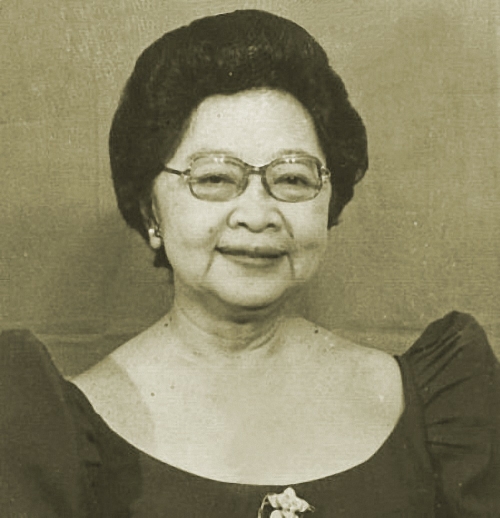
National Artist - Lucrecia R. Kasilag

It is amazing what you find when you try to build your family tree.

From the Philippine Government Website of National Commission for Culture and Arts, I found one of the National Artist is Lucrecia R. Kasilag. She was Dean of the Philippine Women's University College of Music and Fine Arts. She served as Artistic Director and as president of the Cultural Centre of the Philippines from 1969 until her retirement in 1986.


Details of her are as follows:

"National Artist for Music (1989)
(August 31, 1918 – August 16, 2008)

Lucrecia R. Kasilag, as educator, composer, performing artist, administrator and cultural entrepreneur of national and international caliber, had involved herself wholly in sharpening the Filipino audience’s appreciation of music. Kasilag’s pioneering task to discover the Filipino roots through ethnic music and fusing it with Western influences has led many Filipino composers to experiment with such an approach. She dared to incorporate indigenous Filipino instruments in orchestral productions, such as the prize-winning “Toccata for Percussions and Winds, Divertissement and Concertante,” and the scores of the Filiasiana, Misang Pilipino and De Profundis. “Tita King”, as she was fondly called, worked closely as music director with colleagues Lucresia Reyes-Urtula, Isabel Santos, Jose Lardizabal and Dr. Leticia P. de Guzman and made Bayanihan Philippine Dance Company one of the premier artistic and cultural groups in the country.

Her orchestral music include Love Songs, Legend of the Sarimanok, Ang Pamana, Philippine Scenes, Her Son, Jose, Sisa and chamber music like Awit ng mga Awit Psalms, Fantaisie on a 4-Note Theme, and East Meets Jazz Ethnika."

This is how we are connected in the family tree:


Monday, 8 May 2017

Senator Esteban Raymundo Abada

As I mentioned in one of my posts before. One of the most popular people in my family tree was Esteban Raymundo Abada.

From the Senate of the Philippines website I read about him: "Senator Esteban Abada was born on March 15, 1896, in Sarabia, Negros Occidental. Of middle class parentage, the child Esteban grew up in the neighboring town of Kabankalan, where he graduated from the town’s elementary school as Salutatorian. At the age of 14, he went to Manila and studied at Manila High School. He was granted a scholarship and he pursued his studies in the Philippine Normal School, where he graduated in 1915. He embarked on an educational career, starting immediately after graduation as a teacher in the elementary grades. In 1916, he became elementary school principal, and was subsequently promoted supervising teacher. Four years after he started his teaching career, Abada was elected as a pensionado to the United States. Studying in the Michigan, he was elected to the Phi Betta Kappa, a nation-wide fraternity of scholars. He graduated as Bachelor of Arts from that University with distinction, and was consequently awarded a Teacher’s Life Certificate. Returning to the Philippines and to his interrupted teaching career, he served as high school teacher for two years, after which he was again promoted to the position of high school principal, which he held for three years. In 1927, he was a Superintendent of Schools. His first assignment was Zambales, and then he was transferred to Capiz, Tarlac, and Batangas. In 1939, he was designated Administrative Officer of the Bureau of Public Schools. While he was serving as Division Superintendent of Schools before that, he had occasion to associate with the then Speaker Manuel Roxas. In, 1946, after Roxas became President, he appointed Abada Director of Public Schools, and was Undersecretary of Education in 1948. Drafted as senatorial candidate in 1949, he copped second place among all winning candidates in that election. Abada carried his efforts in behalf of education to the halls of the upper chamber of Congress. As an official of the Department of Education, Abada had a reputation as a fighter, taking on even Americans who had a hand in running of that department before our independence. As a Senator, Abada preserved that reputation, to the advantage of educational circles in the country. To his credit he has several important legislative measures affecting education, all enacted into law. He was, aside from his efforts for education, likewise a member of the Philippine Delegation to the United Nations during one of its plenary sessions. Although suffering from an ailment, Senator Abada nevertheless contributed his share of work in the Senate during its 1954 session. He was Chairman of the Committee on Education, and as the session progressed, the ailment took its toll on his health. He went to the United States for medical treatment but never recovered. The educational and political career of Esteban Abada ended in the New York Hospital where he died on Decemer 17, 1954. He was survived by his widow, the former Purificacion Morente, and two children: Ester and Tita." From my research, I also learned that Esteban R. Abada has other children who died young.

Below is my relationship chart with Esteban Raymundo Abada. Our ancestors Andrea and Esteban were siblings. Please click on the picture to enlarge. Living persons are not shown for privacy reasons.